
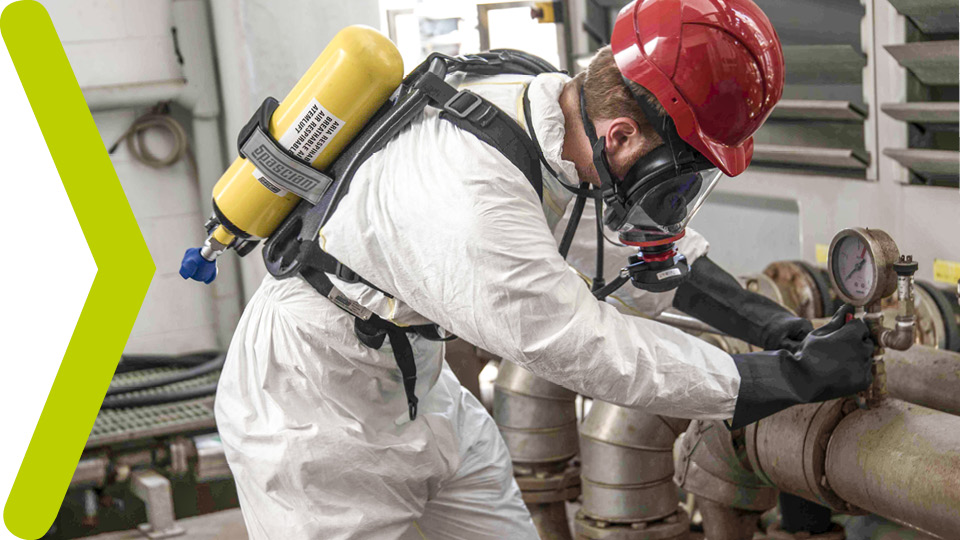

Many safety managers do not take the choice of respiratory protection equipment for industrial applications lightly, and there’s a good reason why. They have many workers to protect, and with the stakes so high and regulations in place, there’s no room for error. The selection of self-contained breathing apparatus systems involves hefty investments, both financially and in terms of program oversight.
Therefore, finding the right fit will not only benefit safety managers and personnel utilizing the equipment but also teach the safety manager a thing or two about equipment specifications and how they fit into the bigger picture of the safety program as well as facility operations.
SCBA Specifications to Know
The basics of SCBA equipment start with what the equipment does and where it’s used. Self-contained breathing apparatus equipment is a full respirator that provides breathable air from a cylinder attached to the wearer; unlike an air-purifying respirator, an SCBA does not rely on the surrounding atmosphere whatsoever. This means that in situations with either unknown or deficient levels of oxygen, or environments where the concentration of particulate or chemicals is too great for a filtering system to handle, SCBA equipment is required.
Industrial applications for this equipment span many fields, firefighting operations, chemical manufacturing, confined space entries, emergency response and industrial maintenance all provide atmospheric hazards that can either be too low on oxygen or contain immediately dangerous levels of toxicity.
What Makes One SCBA Better than Another?
Certain SCBA systems take into consideration which features actually matter when it comes to safe operations. For example, cylinder capacity determines how long a worker can work before needing to exit the situation/change cylinders. Industrial SCBAs typically come in 30/45/60-rated service minutes (although actual work time is less due to exertion from use of the SCBA).
Additionally, facepiece design affects everything from field of vision to communication ability; the newer wide-lens designs actually provide both greater peripheral vision and several compatible attachments for radio integration into a single unit. The third component is weight distribution, while some people may not pay attention to the way a device sits on their back, if it does not sit well or gives pressure points on one’s back, it will tire them more quickly, thereby diminishing effective working time and employing dangers. The harness system should accommodate body types but also keep the cylinder secured during activity.
Moreover, breathing resistance helps workers determine which units they can tolerate; models with lower resistance require less effort which means less fatigue and lower air consumption rates. For frequent extended work periods or scenarios where high exertion efforts are required, this becomes increasingly important. Facilities looking for dependable respiratory protection look to systems like the SCBA designs that provide extra protection for tough industrial locations.
Regulations to Consider
When it comes to industrial SCBAs, regulations are serious. NIOSH certification plays a key role in the selection process; NIOSH is responsible for testing and approving respiratory protection devices so all parts of the SCBA system must be NIOSH approved. Facilities cannot mix and match parts from different manufacturers/models unless testing them under NIOSH circumstances allows for this, as attempted salvaging will void certification.
Additionally, OSHA regulations under 29 CFR 1910.134 regulate respiratory protection standards, which apply to how best to use an SCBA, from medical evaluations to fit testing to actual training requirements (and including maintenance requirements). Facilities must comply with these regulations and equipment standards relative to them for certification.
For instance, if a facility has a fire brigade or emergency response team on site, NFPA standards apply, in particular NFPA 1981 outlines open-circuit SCBAs designed for firefighting purposes and other operations. Even if a facility is not focused on fire response as an open operation, this applies if fire suppression efforts are included in the emergency response plan.
Maintenance vs Long-Term Costs
When purchasing SCBA equipment it is only half the battle; the price paid is just the initial set-up expense. Maintenance costs factor into the service/lifetime of components meant for replacement or adapted use that increase prices as time goes on.
Test cylinder hydrostatic requirements mean additional costs; even though facilities can purchase an additional spare they must have enough cylinders while some are being tested at three or five years (depending on the type) that incurs added costs. Composite cylinders are lighter than aluminum/stainless steel but composite cylinders are expensive if they need replacing at their tested lifespans.
Training also factors into SCBA options; while people must be trained on each specific design with refresher courses yearly (and many SCBAs turn out to be more self-explanatory than others, thus reducing time spent in training), this increases costs over time. General acquisition costs come down mostly through effective implementation despite training requirements.
Using Equipment Based on Operational Needs
Every industry has different needs for service ability when it comes to SCBAs. A chemical plant that frequently has to enter confined spaces may prefer a lighter-weight model that secures air from above. A facility that has emergency response needs may need SCBAs that correspond with clothing used for firefighting efforts. Manufacturing companies that have periodic maintenance in at-risk areas may concern themselves less with weight and more with ease of use/training capability.
Equally important is how often SCBAs will be used. Facilities with daily use support models with parts readily available/longevity preferred for wear. Those facilities looking for SCBAs just as a backup/support in emergency situations can worry more about longevity of parts but storage would have less of an issue with intensive wear.
Finally, environmental conditions at a facility play an essential role in equipment fit. If areas are incredibly hot/cold/corrosive/high humidity it could impact parts’ longevity. Some SCBAs do better than others; often manufacturers will provide specific ratings about temperature ranges and exposure.
Making That Final Selection
Choosing industrial SCBA equipment can be complicated, but it’s always best to compare several options and take various factors into consideration, safety first, before cross-checking them against operational needs than simply relying on price effectiveness/feature length versus what truly matters most.
Using end-users as evaluators can help; those who will wear/use the systems often have real-world feedback (comfort levels, issues when they’re supposed to be fixed/specified) that go above what anyone else may learn during demonstrations/technical information sessions.
Finding units that also come with trial periods/rental options allow facilities to ascertain what’s best for their particular options under actual working conditions – then any compatibility/responsiveness/integration issues come out in the evaluation phase versus post-action and learning then becomes more beneficial within shorter time spans.
The ideal SCBA unit will protect workers while integrating well into safety programs and beyond without hiccups or excessive amounts of troubleshooting. Evaluate options thoroughly through testing prior to implementation within a reasonable timeframe, bring all possible voices into the discussion and field testing to make it as safe of a space as possible for all levels of wearers/users supports collision-free adjustments after the fact.
Comments are closed.