
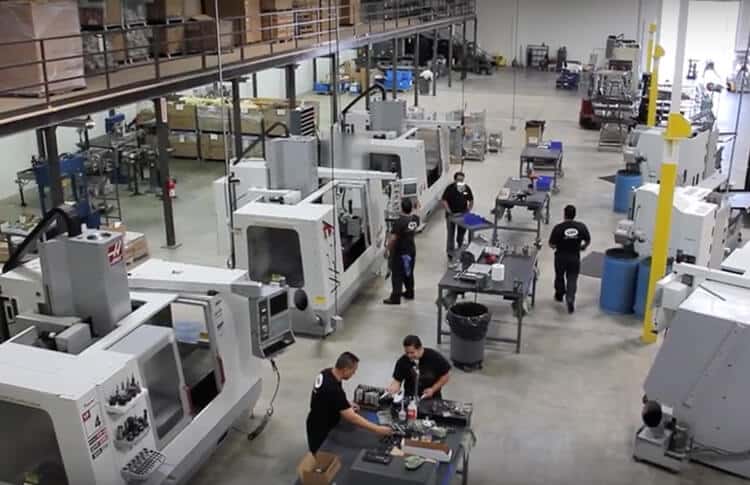

Eventually, every machine shop will reach that pivotal moment when business is booming. Parts orders are rolling in, current CNC equipment is nearing capacity, and expansion opportunities abound. But then reality sets in. That next machining center costs $150,000-$400,000. What was once a golden opportunity quickly transforms into a life-altering risk.
But the truth is, that next piece of equipment may not even need to be new. The numbers for used CNC equipment make far more sense when for shops that are growing and need to ensure money goes a little bit further.
How Equipment Values Actually Work
Brand new CNC machines depreciate in value the moment they hit the shop floor. In fact, the expected depreciation after year one runs 15%-25% of the purchase price. A machining center purchased for $200,000? It’s worth $150,000-$170,000 twelve months later regardless of maintenance or hours.
This means that for a savvy buyer, purchasing someone else’s CNC machinery that’s three or five years old is an ideal situation. They’ve taken the depreciation hit already. The first owner paid for the privilege of “first in line,” meaning the new owner basically inherits a piece of machinery with far more value for its money.
And in terms of general company health, instead of a fleet of new machines wasting $120,000 annually in unseen value, a shop can apply that capital to investing in staff to hire operators with the necessary skills, better marketing efforts, or even maintaining working capital balances for when opportunities arise.
What You’re Really Getting with Used CNC Equipment
When it comes to used equipment, it’s helpful to know a few key terms. Although “pre-owned,” “used,” “refurbished,” and “remanufactured” all indicate different levels of condition, knowing them helps when finding the best deal.
As is used means that the buyer gets it as-is. Sellers maintained everything properly (in some situations) and if someone has great knowledge on CNC machinery, this can be a great deal. But since these come with more variance, they require inspection.
Refurbished units go through inspection and repairs. Worn parts are replaced, accuracy is checked and confirmed, and before any machinery returns to market, it’s tested. This is a compromise without the high cost of new.
A step above refurbished machines are remanufactured CNC machines. Key components undergo processes where they are essentially rebuilt or completely replaced. Control systems receive updates, and the machine is restored back to original specs (or as close as possible). These come at higher costs but operate nearly as good as new.
For companies looking to expand production capacity but maintain a sound financial balance, quality used CNC machines from Premier Equipment provide access to better-than-average inspected machines that have been assessed and polished for production work, assuming the buyer works with reputable suppliers who don’t just flip machines from one shop to another instead of truly standing behind their machines.
Where Used Equipment Is Best
There are some situations where new machines are justified. For example, high volume production with extremely close tolerances necessitates a certain expenditure. Manufacturer support for parts-specific jobs or revolutionary technology makes no sense outside buying new and having legitimate support.
However, most growing shops do not exist in this environment. They exist based on diverse jobs and customer loyalty and building capacity shouldn’t risk the entire operation. Where used CNC machines make sense is in the day-to-day endeavors.
Consider this scenario: a shop requires additional capacity to compensate for overflow work coming off its current machining center. This doesn’t need to be cutting edge technology; it just needs to perform. A brand new $300,000 machine needs to generate approximately $75,000-$100,000 per year to justify such a capital investment (assuming 25% profitability on a five-year contract).
For a well-maintained $120,000 unit, that number drops to $30,000-$40,000 because shop owners don’t need to pay off the price of the investment but instead need that machine to complement and supplement existing work to maintain profitability.
The same is true when exploring new markets. Trying out a new niche sector with a $250,000 commitment isn’t worth it, because it’s not worth it. Trying out a new opportunity with $80,000 worth of used CNC equipment? That becomes manageable as it provides the flexibility not just to adjust if things don’t pan out but also to continue investigating expansion opportunities within the scope of that investment.
What Actually Makes a Good Used Machine
Hours mean everything but nothing at all. A machine with 15k hours and documented maintenance is better than one with 8k hours and no one knows where it’s been. Spindles are expensive to replace ($8k-$40k depending on the machine) so if there’s noise beyond average tolerances or vibration/play in the spindle, it might be an expense down the road worth avoiding. Check out these things during your inquiry.
Control systems matter but maybe not as much as most assume. Fanuc 16i and Siemens 840D controls are older yet equally capable of most jobs; newer generations add functionality but good ol’ reliable milling and turning works just fine on older platforms. In addition, parts are more available since techs universally know how those controls work inside and out.
Most importantly, what’s not negotiable are the integrity of the machine. Worn ways, ball screws with damage or bed issues run into hundreds of thousands of dollars to repair (and never come back fully accurate). Those aren’t easy swaps. A great “skeleton” with older controls beats even a sub-par machine with newer retrofitted controls nine times out of ten.
How Financials Work
Banking values differ slightly with used versus new machinery loans; loan-to-value ratios range from 60%-80% for used equipment versus 80%-90% for new equipment (meaning slightly more cash down or additional collateral).
Yet even factoring those costs into play, used has far more financial sense than any other solution. The difference between 20% down on a $300k piece is $60k; on a $120k piece it’s $24k. That $36k price differential may not sound significant, but to a growing operation it provides three months’ worth of working capital, enough for an aggressive marketing push or even sustenance during acquisition when productivity takes a temporary decrease.
That type of flexibility counts like you wouldn’t believe. Growing operations need capital in multiple places at once, with equipment yes, but also inventory and receivables and payroll, and when unexpected growth opportunities arise, the last thing someone wants to do is spend $180k more than necessary on equipment; they want their capital available to spend where it makes more sense.
How to Set Yourself Up for Success
Buying used takes more effort than simple ordering from a catalog of new machinery for sale. It takes time and focus to inspect machines. It takes thorough questioning and review to deduce a CNC machine’s history. Transport and installation involve extra caution because used units won’t have factory installation teams.
They’re not pitfalls, they’re a wise business investment that ensures protection on investments. Shops that take used purchases seriously and partner with reasonable suppliers who come recommended end up consistently discovering solid solutions that provide additional years of life at less than half or two-thirds of the cost.
It’s not about saving upfront money over time, that’s just an added bonus. Instead, it’s about limiting financial exposure while creating production capacity that allows for sensible growth; the two should never equate potential risk, but with used CNC equipment, too often price is too good to ignore along with functionality afforded through acquired capabilities, as long as used condition makes sense under pre-defined guidelines set forth here. Saving money allows for other investment potential while capability allows for additional work, and the two create momentum instead of restriction.
Comments are closed.